
Lessons Learned from July 4th Prevention Project
Every July 4th, we hear the same advice:
Keep pets indoors.
Update microchips.Prepare a safe space.
Talk to your veterinarian.
Start training early.
This year, Life of Kai joined the chorus, but we also decided to run a small experiment.
Over the two weeks leading up to Independence Day, we posted a series of educational "Did You Know?" memes on Nextdoor hoping to repeat important information often enough that it might stick.
At the same time, we piloted a second intervention: free lost pet phone cards designed to guide people through the confusion and panic that often follows a missing or found pet incident. And a third intervention by giving out free third party airtags to high risk pets.
The July 4th Meme Experiment
We posted six educational memes for 2 weeks.
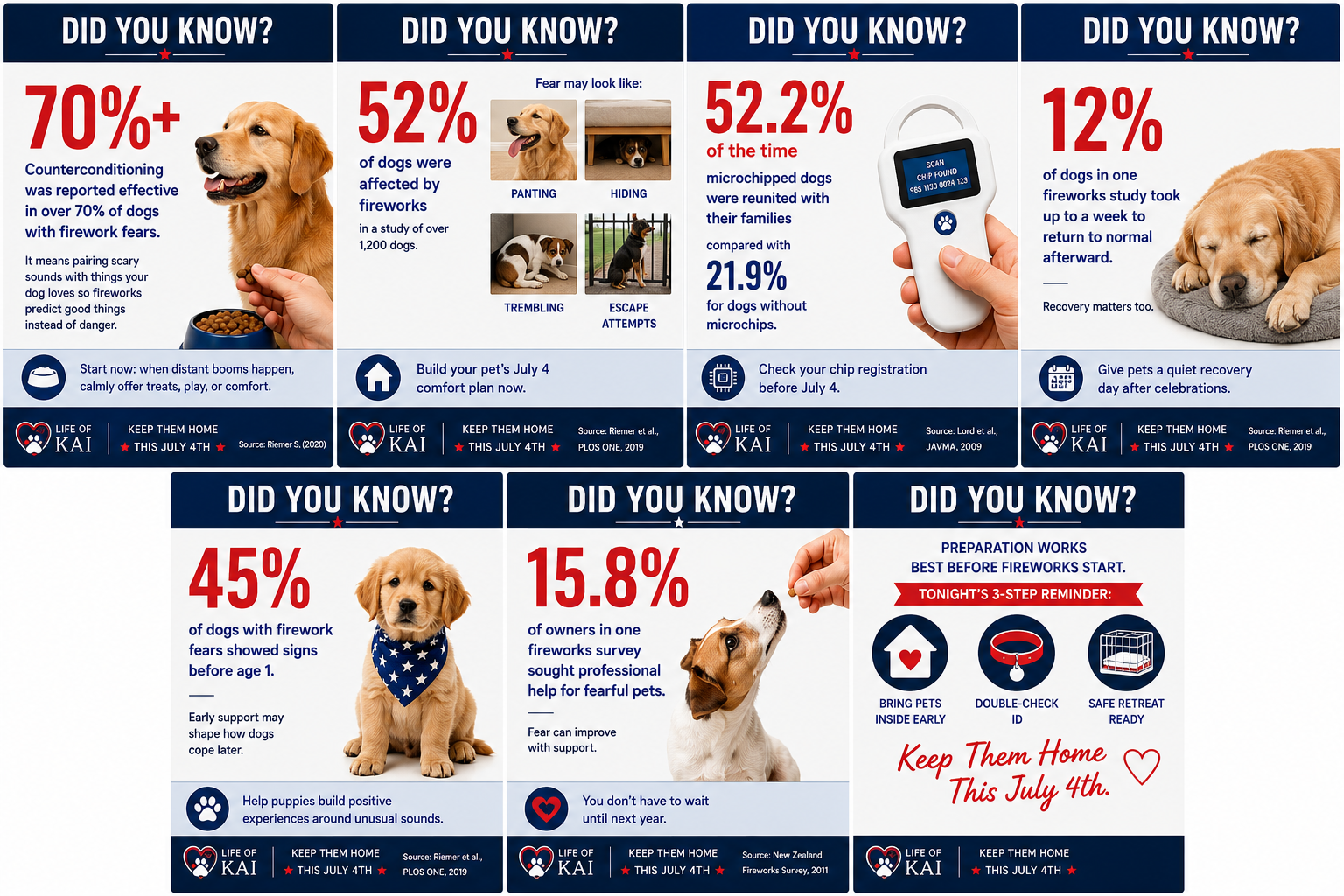
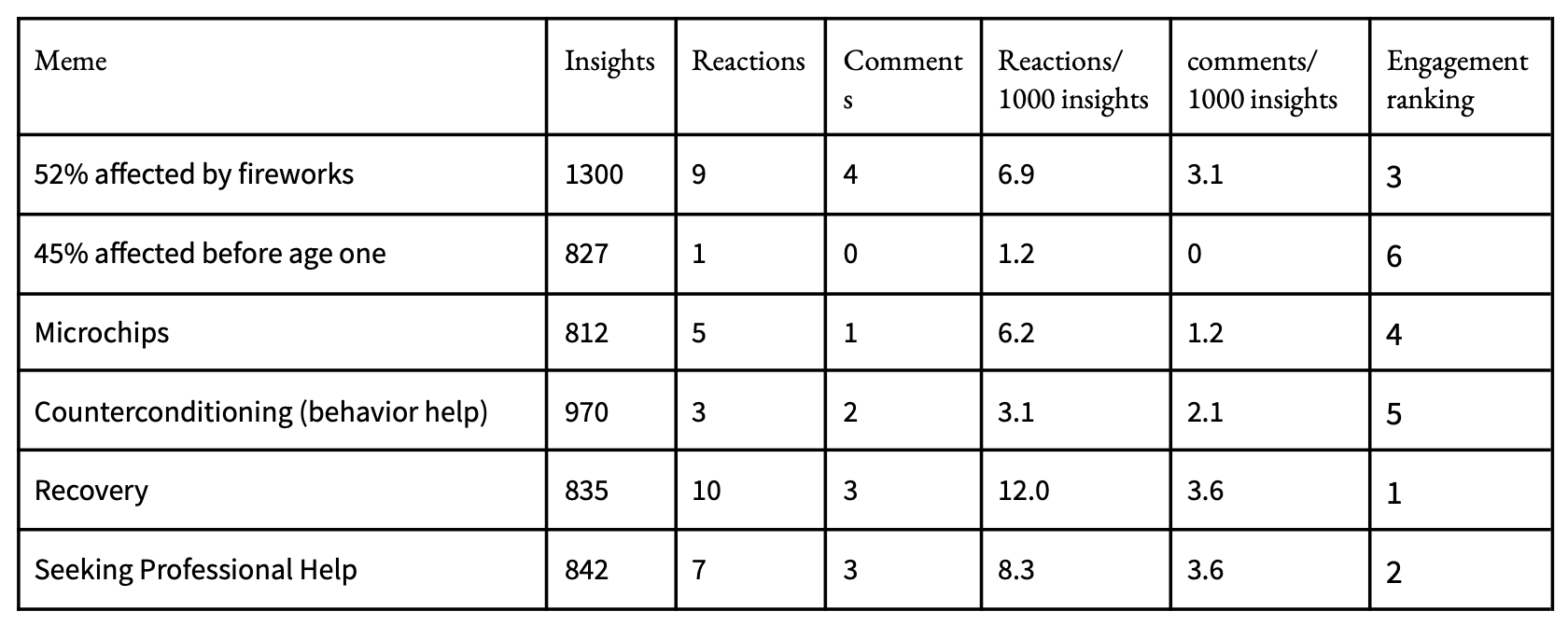
Nextdoor gives us three useful measures of engagement:
Views (Insights)
Reactions such as likes or thanks
Comments
In many ways, this approach became an accidental form of naturalistic observation and unlike surveys, people either engaged or did not but their reactions told us stories about their pets, themselves and July 4th.
The results surprised us.
The highest engagement did not go to intervention strategies or prevention tools. Instead, the top performing posts shared something else in common: they validated experiences people had already observed in their own dogs.
"Yes, my dog does take several days to recover."
"Yes, my dog struggles with fireworks."
The memes resonated because they felt familiar.
The Effort Gradient
We believe engagement appears to decrease as the effort required from the public increases. Raw data in the first 3 columns and calculated rate of engagement in the last three. Efforts are determined from engagement ranking.
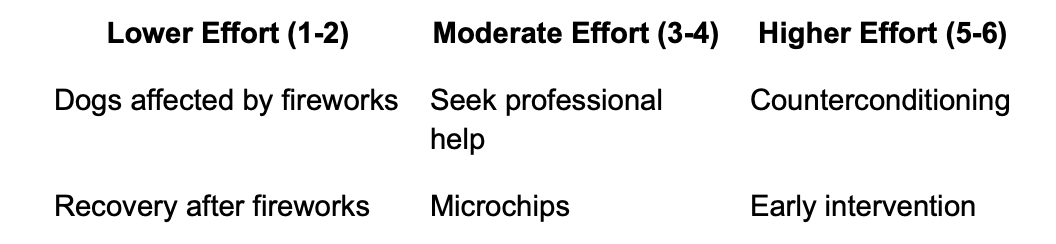
Lower effort aligns with familiar experiences, Moderate effort suggests future actions and Higher effort requires learning new skills, changing habits, investing time, or acting before a problem surfaced. Therefore, prevention asks a lot of us.
The Curious Case of Counterconditioning
Counterconditioning may deserve its own category entirely.
The resistance didn't seem to center around whether dogs suffer from fireworks. Most people appeared willing to accept that premise. Instead, the discussion often centered around the intervention itself — particularly the use of food. Counterconditioning asks guardians not only to invest time and consistency, but sometimes to reconsider long-held beliefs about how dogs learn and how fears should be addressed.
Changing a habit can be difficult. Changing a worldview can be even harder.
The Silent Audience
Another interesting observation emerged from the comments section. Most comments came from a very small number of repeat participants, while hundreds of people viewed the posts quietly. The loudest voices online are not always the majority opinion. The silent audience may ultimately be the most important audience of all.
The Mysterious Microchip
Microchips occupy an interesting middle ground. Once implanted, they require very little effort. Unfortunately, they are also invisible. Unlike collars or tags, there is nothing reminding us they exist. A microchip is also only as useful as the information attached to it. Registration and updates matter, and unfortunately that extra step can become a surprisingly large barrier.
We tried to remove a step by providing chip reading service but no one needed help. We think this is a logistic problem. To read the chip, the pet has to be present. Making arrangements to connect with the guardians and their pets require planning. Ironically, chipping is the most reliable technology. Once implanted, the chip stays with the dog and remain detectable for years.
The Phone Card Experiment
Even before we analyzed the meme results, we suspected effort might matter. The phone cards were our attempt to reduce decision making effort in a stressful scenario.
The idea was simple: If someone loses or finds a pet on July 4th, they don't need more stress or more decisions. What if the instructions were already in front of them? What if we could remove the need to remember what to do next?
Surprisingly, interest in the cards was low. We suspect that not all effort was removed. People still need to understand the card instructions, remember where they put the card and retrieve them during an emergency. Furthermore, we offered to make the cards available at the library which means people have to get to the library. We essentially created a distribution issue. Perhaps, for many people posting lost or found dogs on Nextdoor is the path of least resistance - low effort. What people don’t realize is it might be hours before anyone sees the post, and by then, precious time spent looking for a lost dog was gone.
The Airtag Saga
We had a similar experience with our Airtag project.
Unlike microchips, Airtags are visible. They provide immediate feedback. People can open an app and watch their pet's location update in real time rather than waiting for a finder to scan a chip. And yet participation was still limited. The effort is low as the set up process takes only a few seconds. However, the effort is more than just setting up, it is how to navigate the technology once the tag is connected to the phone. For some, technology is a barrier and prevention asks us to solve a problem that does not yet exist. - My dog is not going to get lost, why I need the airtag mindset.
We also discovered that several people have already put AirTags on their pets. Polling the public to see how many currently use airtag and ask about their experience would certainly be beneficial to our learning process.
Final Thoughts
Microchips. Phone cards. Emergency kits. Insurance. Airtags. They belong to the same family: Prevention.
When we began this project, our goal was prevention. We wanted to keep pets out of shelters and safely home with their families. We assumed the challenge would be convincing people that prevention matters. Instead, we discovered something we hadn't anticipated. Every prevention strategy we explored required people to complete a series of small steps before any benefit could be realized. Individually, those steps seemed trivial. Collectively, they created friction. The lessons we learned from this project was where people drop out of prevention.
How about education?
Our project interventions are all attempts to remove steps to make things easier. The educational memes help remove the effort of finding information, the phone cards are to remove the effort of remembering what to do, AirTag orientation is to remove the effort of learning the technology and community chip scanners are to remove the effort of finding a scanner. We are doing more than just educating. Perhaps the question isn't simply how to educate communities about prevention. Perhaps the greater challenge is designing prevention systems with so little friction that doing the preventive thing becomes the easiest thing to do. Most preventive measures share one characteristic: the work comes first, while the reward is delayed and uncertain. Every additional step becomes another opportunity for paralysis.
Our next step is to continue to find ways to eliminate steps, making engagement as easy as possible.